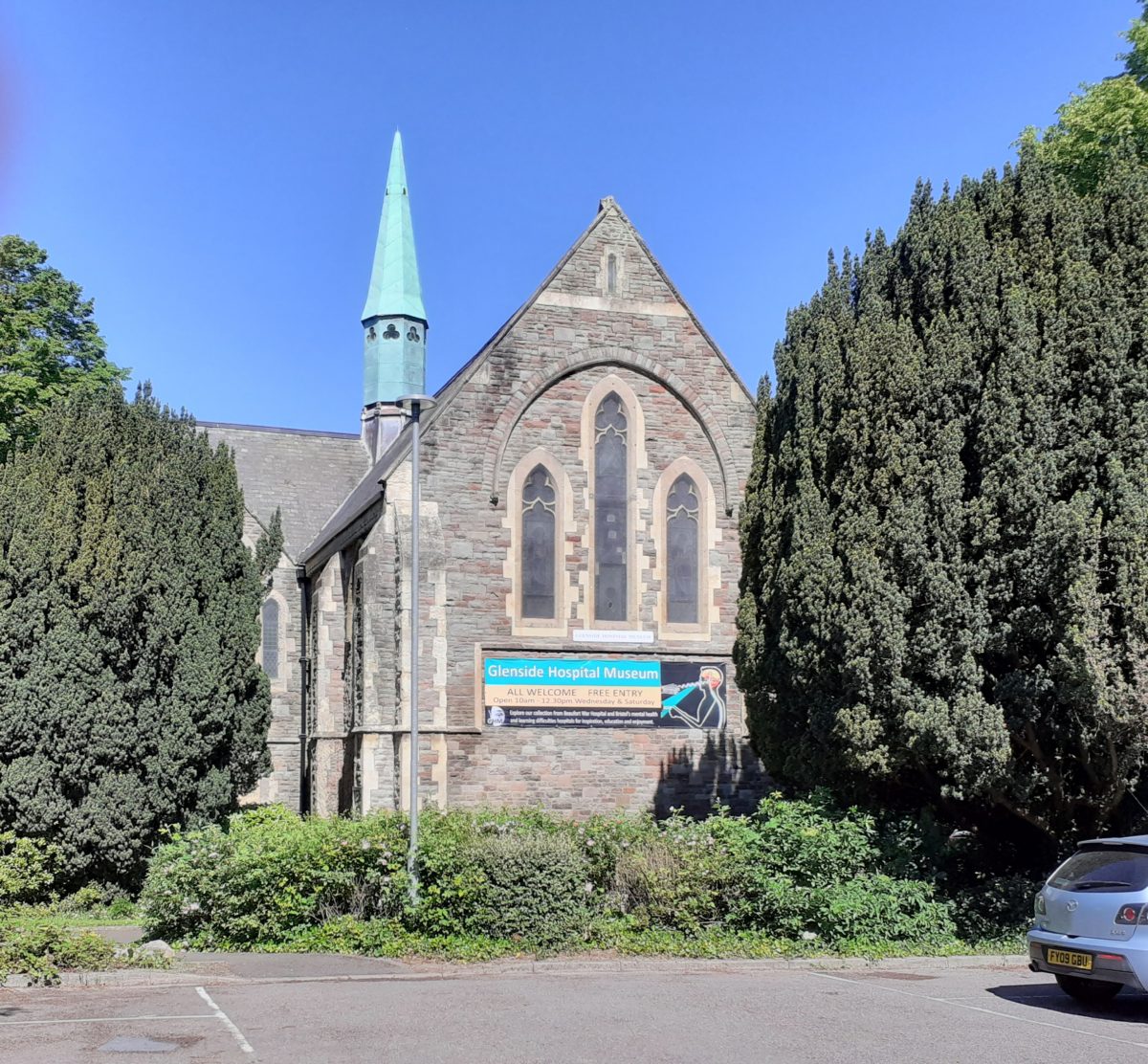
People find all sorts of unexpected uses for deconsecrated churches and chapels. One Bristol church is even used as an indoor climbing centre.
But today I would like to take you through this door.

You might find some surprises. Glenside Campus is now part of the University of the West of England. It provides training for nursing and midwifery students and allied health care professions. I studied nursing there myself many years ago and enjoyed the picturesque grounds. However, the building had a former use as a large Victorian mental hospital. Opening in 1861 as the Bristol lunatic asylum.
The first lunatic asylum in Europe was the Bethel Royal Hospital (Bedlam) in London. Before the madhouse act of 1774 treatment was carried out by non-licensed practitioners who ran their madhouses as commercial enterprises often charging visitors a fee to watch the inmates. In 1808 the county asylum act was passed which allowed counties to levy a rate in order to fund the building and running of county asylums. The government wanted to remove the insane from workhouses and prisons.
Bristol lunatic asylum
Bristol corporation vacillated about providing an alternative arguing that they already had to spend heavily on sewage and other sanitary measures. The Bristol Gazette joined in saying it would be “lunacy itself to build a new asylum: “to take a pauper simply because he is mad and to place him in a palace with pleasure grounds, ornamental water, etc. is nothing short of philanthropy gone mad.”
After much argy bargy Fishponds was chosen out of eight possible sites and work began in 1858. It was designed by Irish architect Thomas Royce Lysaght.

When we were there some students claimed to be able to identify which were the male and female wards by smell. The windowsills all slope downwards to prevent people standing on them to jump.
Beaufort Military Hospital
During the first world war, the war office requisitioned the building and renamed it the Beaufort military hospital. The hospital specialised in orthopaedics. British artist Stanley Spencer worked there as a medical orderly helping to nurse soldiers from the western front.
Glenside Hospital
After the war, it reverted to being a mental hospital but they renamed it again to avoid stigmatising the patients. Glenside hospital became largely self-sufficient with its own giant laundry, sewing room and farm including a piggery. Patients were expected to work hard for low pay. Men and women were kept on separate wards and work was allocated according to gender. Male patients worked on the farm and in the gardens and greenhouses, helped with maintenance or repaired shoes. Women worked in the laundry, kitchens and sewing rooms or were allocated to cleaning tasks.
I have met older patients who talked about the harsh treatment they received and the difficulty they had trying to leave. Early treatments included deliberate infection with malaria to treat syphilis and insulin therapy for schizophrenia. Many patients stayed for years as they had nowhere else to go. In the 1960s scientists discovered better drugs to treat mental illness and there were fewer long-stay patients. Eventually, the last patients moved into the community and Glenside hospital closed in 1994.
Glenside hospital museum
Psychiatric care has changed a great deal but it is good that today’s students learn a bit about the history of care for patients with mental health problems and the former hospital chapel has been turned into a museum run by volunteers. It also has exhibits from the Beaufort hospital days and local hospitals for people with learning disabilities such as Stoke Park.
Dr Donal Early a consultant psychiatrist at the hospital collected many of the artefacts and old photos and first displayed them on the balcony of the dining room.

Most chapels don’t have a machine for electroconvulsive therapy or a padded cell.
Conditions must have been very cramped when the hospital housed over a thousand patients. Privacy was minimal.


If you would like to visit the museum is open to the public on Wednesday and Saturday mornings. The 48A bus runs from the centre and stops right outside. The museum is not suitable for young children.
Address
Blackberry Hill, Stapleton, Bristol, BS16 1DD
This post will be added to #thursdaydoors, a site where door lovers from around the world come together to share their latest finds.
8 responses to “Glenside hospital museum a new use for an old chapel”
Tried to like but it was continuing to ‘load’. Interesting museum!
Fascinating, but I’m not sure I’d love to visit. I’m rather emphatic and would feel their pain.
Lovely building but what struck me were charging to view the inmates and the slanting window sills. Fascinating if not uplifting history.
janet
My mother worked for a state-run mental institution in the 60s. Treatment wasn’t too harsh then. Patients did work on a farm and in other industry, but that was stopped by 1970. The hospital has long since closed.
I would love to tour this place. The building is beautiful, and the history is important.
I worked for a while in a learning disability hospital. Most of the staff were kind but there was a sense of lives being wasted.
Interesting use if the chapel. How cruel treatment of the mentally ill was.
I wish that I had read this, and your other great posts on Bristol, BEFORE I had visited there. I will now need to arrange to go back! 😀
You are always welcome to visit