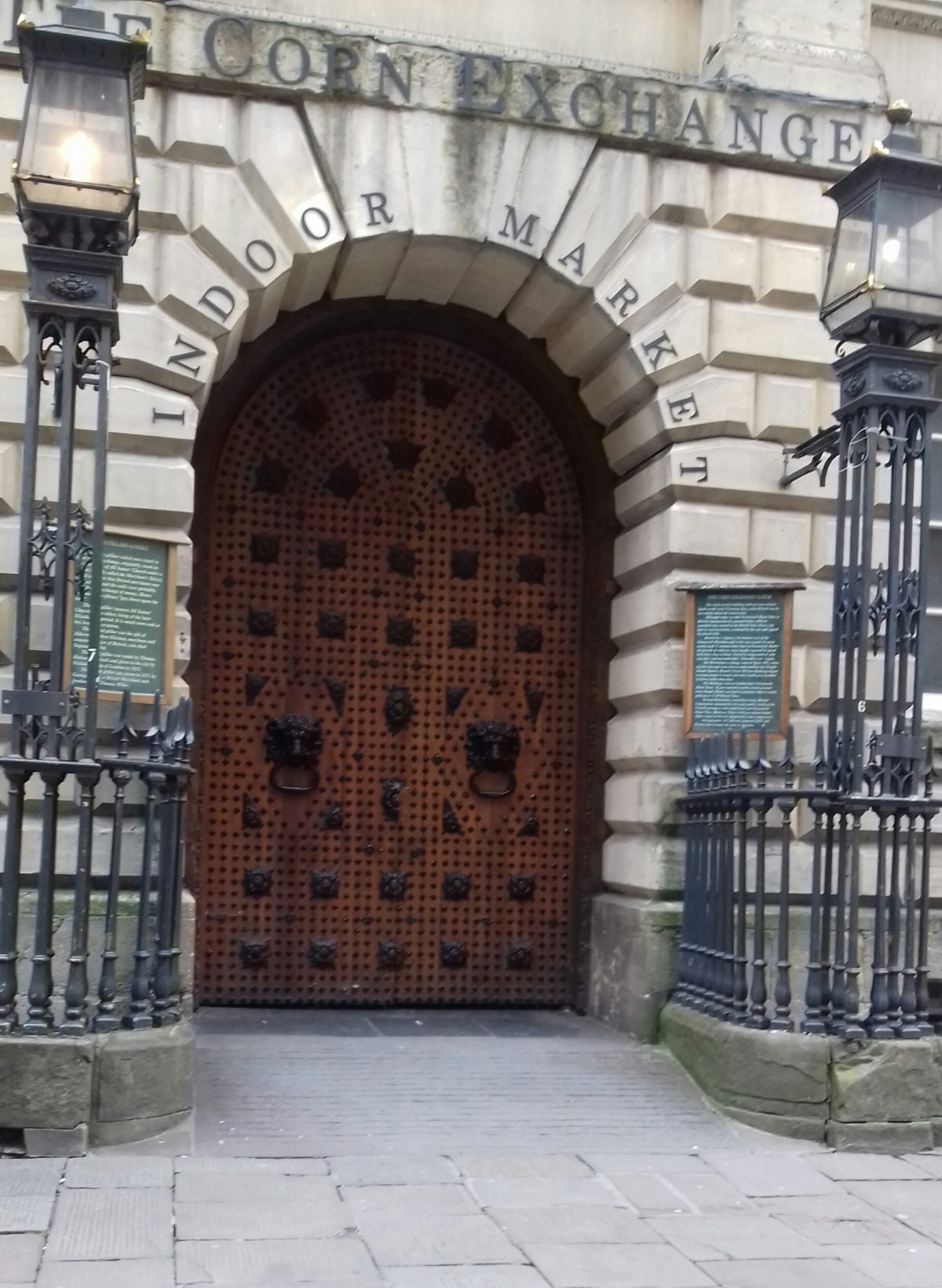
In England, non-essential shops and indoor markets were shut due to the coronavirus pandemic and this gave me the chance to notice doors that would normally be open including these heavy wooden doors with the impressive lion door handles. These days these doors open to reveal the bustling St. Nicholas Market where you can buy everything from old books to oriental fabrics. Understandably St. Nick’s is very popular with locals and tourists alike.
Corn street where the market is situated, together with Broad Street, Wine Street and High Street are the four cross streets which met at the Bristol high cross when Bristol was a walled medieval town. The high cross itself is now at Stourhead in Wiltshire but some of the old city survives
The history of the Corn Exchange
The covered part of St. Nicholas market is housed in the old Corn Exchange building.

The exchange was built between 1741 -1743 based on the designs of John Wood the Elder who was also responsible for much of Georgian Bath. A corn market was held in the exchange every Tuesday and Thursday during the nineteenth century.
In the 1960’s it became a popular concert venue hosting groups such as the Rolling Stones, the yard birds and cream. The stage area is now occupied by a stall selling old rocks and fossils. I wonder if it is a happy accident. Other stalls sell records and rock memorabilia.
Close by was the location of the first Berni Inn which became the Rummer and is now a gin bar. At the back of the market was a pub called the Elephant which had a market license which meant they could sell beer from six in the morning.
The Nails

Four nail shaped tables stand outside the market and are supposed to be where merchants could conduct their business in the 17th century. The edges are raised to prevent coins from falling off. They are said to be the origin of the phrase paying on the nail and the oldest is said to date from Tudor times.
Another interesting feature is the market clock.

It has two minute hands to show the time in London (GMT) and the time in Bristol. It was not until the arrival of the railways that Bristol adopted London time. We used to be eleven minutes behind.
Air raid shelter
Bristol’s largest air raid shelter was situated in the cellars under the market. It is sometimes open during open doors events. I recently visited it on a walking tour. Duncan our guide is a local street artist responsible for some of the blue and yellow tubular sculptures round Castle Park. He was very enthusiastic, entertaining and knowledgeable. He would like to make it into a museum and has built up quite a collection of war time artefacts. It was easy to imagine what it would have been like to spend time in the shelter during the blitz. You can still see some drawings on the walls and some of the original signs. In 1940 much of the old centre of Bristol was destroyed.
We were also able to visit part of the upper floor and see how the building would have looked before the roof was built.
Visiting St. Nicholas Market
The market is open from 9.30 a.m. to5 p.m. Monday to Saturday. It is divided into three sections, Exchange Hall, a large open plan trading area, Covered Market, a series of individual shops and alleyways and Glass Arcade where you will find a huge range of world food stalls with enticing smells.
If you are feeling hungry you will find a range of local stalls and independent eateries offering products from pies to pasta.
There is a farmer’s market in the nearby Corn Street on Wednesdays and a Street food market on Tuesdays and Fridays.
Click here for more suggestions of things to see in Central Bristol.
This post was added to Thursday doors. Thursday Doors is a weekly feature allowing door lovers to come together to admire and share their favourite door photos from around the world. Feel free to join in on the fun by creating your own Thursday Doors post each week and then sharing your link in the comments below, anytime between Thursday morning and Saturday noon (North American eastern time).
12 responses to “Visiting St. Nicholas Market in Bristol”
Beautiful door photo. Such an interesting history of this building. Thanks for sharing!
Very interesting history and that door is pretty substantial!
Now I too know the origin of the term ‘paying on the nail’. Thank you.
I didn’t know that about ‘paying on the nail’ and I’ve almost certainly walked right past them on numerous occasions and not noticed them so I’ll keep an eye out for them the next time I go there – which may not be for a while until things get back to normal!
Normally the whole area is crowded with people and there is often a farmer’s market outside.
I know. I’ve been there many times and often just have an aimless wander about there soaking up the atmosphere.
A Tudor table! That’s a treasure.
That’s an impressive door!
janet
That is one massive old door!
Thanks for sharing this 🙂
I never knew the origin of the phrase “paying on the nail” before! Thank you. The door to the Corn Exchange is magnificent. I imagine it must be really heavy to open and close.
I imagine when it was a corn exchange they were very scared of robbers.
I’m sure you are right! Actually, they probably still are.