It has been a strange spring here in England. Halfway through March, the country was put into lockdown and we could only leave the house for essential shopping and short periods of exercise. For almost three months I have not been further than I can walk. My google timeline reads 19 miles in March, 19 miles in April and a heady 26 miles in May. Now however the government is slowly easing the draconian restrictions and up to six people can meet up outdoors provided they social distance.
During lockdown, our walk in the past history group has become a zoom in the past which has enabled us to keep in touch, but I miss face to face contact. This week we were able to meet in small groups to reflect on the recent protests in Bristol and learn a bit more about Bristol’s part in the slave trade and also its part in the abolition of slavery.
Bristol buses have continued to run during lockdown but we have been advised to use them only for essential journeys. Now measures have been put in place for social distancing with alternate seats taped off and passengers required to wear masks so we can travel again. It was great to be able to do something as normal as joining a walking group even in strange circumstances with most shops still shut and Bristol still unnaturally empty.
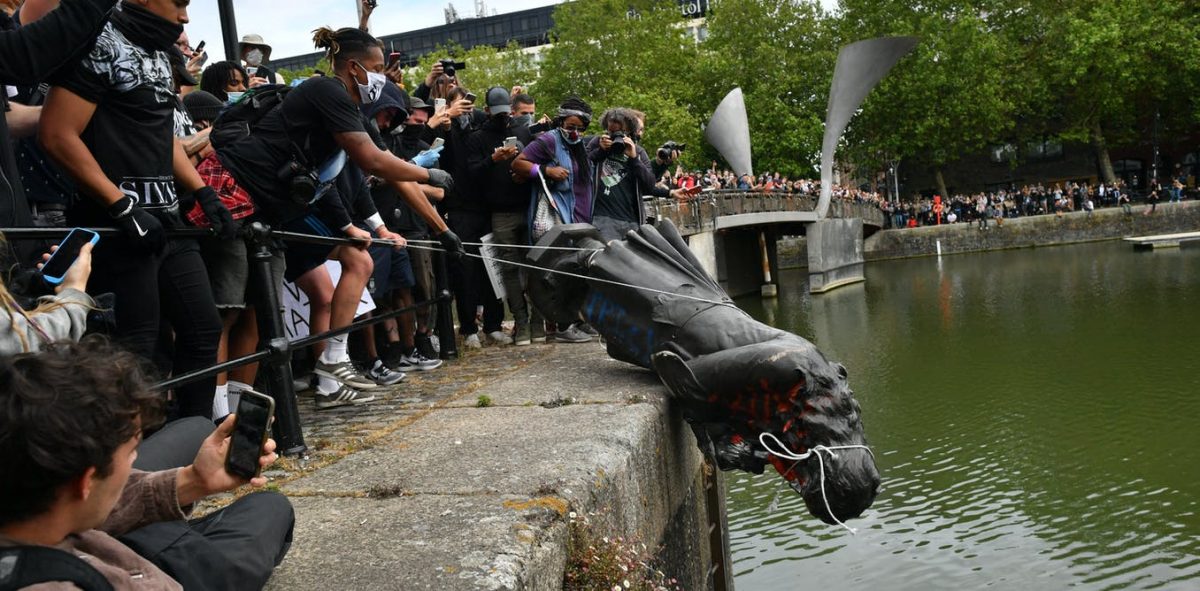
I watched the Black Lives Matter protests in America after the murder of George Floyd by the police in Minneapolis and knew that something similar was planned for Bristol. Even so, I was surprised to see dramatic film of protestors throwing the statue of Edward Colston into the harbour last weekend.
Edward Colston
Edward Colston (1636-1721) has been a controversial figure in Bristol’s history for many years. He was born in Bristol but moved to London. He was a merchant who became director of the Royal Africa company which had a monopoly over the British slave trade. It is estimated that this company alone was responsible for transporting over 89,000 slaves about 20,000 of whom died on the voyage. Colston came back to Bristol to live and became an M.P. for the city.
At the end of his life Colston gave away his vast fortune and this benefited Bristol churches, schools and almshouses many of which still bear his name. The Victorians celebrated him as a hero and his slave trading past was conveniently ignored.

In 1895 James Arrowsmith, the president of the Anchor Society, raised £1000 to have the statue of Colston erected in Bristol city centre. His intention was to commemorate Colston’s philanthropy. Bristolians have become increasingly uneasy with this legacy and when protestors threw the statue into the harbour neither the local mayor nor the police intervened. I think most Bristolians feel like me that while it is wrong to airbrush history celebrating this past is not acceptable in the cosmopolitan and creative city Bristol has become.
An interesting postscript to the story of Edward Colston.
Bristol city council decided to retrieve the statue to prevent it from falling into the hands of scrap metal dealers or far right extremists and used a crane to raise it from the water. It was taken to M shed, a local museum and when staff were cleaning it, they found an old titbits magazine hidden in his sleeve as a time capsule.
Bristol and the abolition of slavery

Bristol’s uneasy relationship with slave trading goes back at least to the time of the Vikings. Bishop Wulfstan of Worcester campaigned against Saxon slaves being sold in Bristol and transported to Ireland and was largely responsible for ending that trade in the C11th century.
Protests against the transatlantic slave trade.
The evidence of the slave trade is easy to find in Bristol and the subject has recently featured in a BBC documentary series a house through time
The part Bristol played in the abolition of the trade is perhaps less well known. One of the leading figures of the abolition movement was Thomas Clarkson 1760-1846. He was the son of an Anglican vicar who became convinced slavery was immoral while a student at Cambridge. Clarkson’s main contribution was to gather data that politicians like Wilberforce could present to parliament. At great personal risk, he visited ports like Liverpool and Bristol and interviewed sailors about conditions on slave ships. He also filled a chest with African goods such as hardwood that he thought could be traded for a profit and had a model made of a slave boat which showed the terrible conditions slaves were kept in. In 1807 the transportation of slaves was banned in the British Empire though it would take a lot longer before it was made illegal in the U.S.A.

We walked to the Severn Stars public house in Thomas Street where Clarkson stayed while in Bristol but unfortunately, we could not enjoy a drink on this occasion as pubs are still closed.


The seven stars refer to the plough which points the way to the pole star which indicates North and was used as a symbol of the anti-slavery movement as escaped slaves headed north to Canada.
The leader of our walk is donating all profits to Bristol mind a local mental health charity as he does not wish to profit from the slave trade. I am sure mental health services will be very busy this year.


8 responses to “Who was Edward Colston?”
A very interesting read. Slavery was a major part of history. It’s the hope of all that history teaches us to become better people, rather than people denying or changing history.
Interesting addition to the story, learning about Clarkson.
I knew about Thomas Clarkson as my daughter’s friend worked as a barmaid at the seven stars.
Hi Anne, All of this did consume the news sites. For good reason. Thank you for sharing more information. The post script is extra interesting. Great photos! Take care.
My sisters went to Colston’s Girls school and on the first Friday in November the girls would place bronze chrysanthemums on the statue as part of their Commemoration celebrations.
My mum went there as well and told me about a commemorative service in the cathedral every year when they were given a large bun.
Very interesting piece. I hate seeing these works of art destroyed and think of the money that has gone into the procurement of them. But I understand the need to pull them down. My daughter explained it to me in terms that really hit home…would I want a statue of Hitler standing in my town, even if at some time in his (early) life or childhood he may have been a very nice chap?
I think it had to come down. I could not explain to black friends why we had a statue of a slave trader in the middle of the town.